Hotline: 1-866-986-BYOD
Unified Endpoint Management (UEM)
Centralize deployment, security, and lifecycle management for every endpoint: mobile, desktop, rugged, wearables, and IoT across Android, iOS/iPadOS, Windows, macOS, and Linux.
What is UEM (Unified Endpoint Management)?
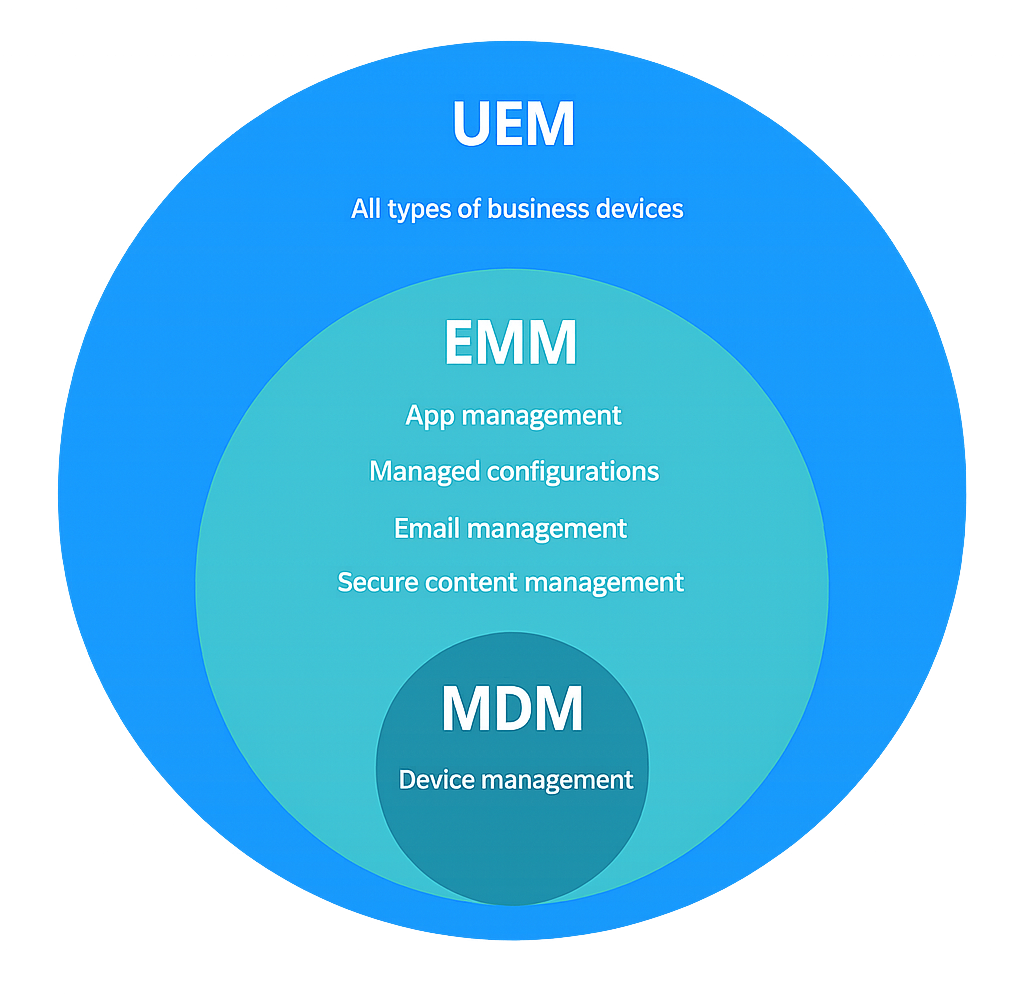
Unified Endpoint Management (UEM) is the next evolution of Mobile Device Management (MDM) and Enterprise Mobility Management (EMM). A UEM platform brings device management, application management, identity and access management (IAM), network and security controls, and endpoint compliance together in one console. UEM spans mobile (Android, iOS, iPadOS), desktops (Windows, macOS, Linux), and emerging endpoints such as wearables, rugged scanners, and IoT.
Codeproof delivers cloud-based UEM (SaaS UEM) so IT teams can enforce Zero Trust principles, run conditional access, and standardize patch management, configuration management, and asset inventory across every endpoint regardless of operating system, ownership model, or location.
How it works
- Onboard endpoints via Zero-Touch (Android), Apple Business Manager, and Windows Autopilot
- Apply policies (security, Wi-Fi/VPN, certificates), distribute apps, and schedule OS updates
- Monitor health, posture, and compliance with real-time dashboards and alerts
- Automate remediation and restrict access for non-compliant devices
UEM capabilities
Codeproof Cyber Device Manager unifies the controls that used to live in separate MDM, EMM, and endpoint security tools:
Cross-platform endpoint management
- Single console for Android, iOS, iPadOS, Windows, macOS, and Linux
- Support for company-owned (COBO, COPE, COSU) and BYOD work-profile models
- Rugged, kiosk, and IoT endpoint coverage with OEMConfig for Zebra, Honeywell, and Samsung Knox
Configuration & patch management
- OS update management and patch deferral for iOS, Android, Windows, and macOS
- Configuration management: Wi-Fi, VPN, APN, certificates (SCEP/PKI), email, and managed app config
- Asset inventory, hardware reporting, and SCCM/Intune migration paths
Endpoint security & Zero Trust
- Zero Trust posture checks before granting access to corporate resources
- Conditional access and quarantine for non-compliant endpoints
- Mobile threat defense (MTD): jailbreak / root detection, Play Integrity, Verify Apps
- Encryption (BitLocker, FileVault), Defender / firewall enforcement, and endpoint compliance reporting
Identity & access (IAM)
- SSO via SAML / OAuth with Okta, Azure AD / Entra ID, Google Workspace
- SCIM user provisioning and role-based access control (RBAC)
- Conditional access integration tied to device posture
App, content & policy management
- Silent install via Managed Google Play, Apple Apps and Books (VPP), and Windows MSI/MSIX
- Mobile content management (MCM) with secure document distribution
- Allow / deny lists, app permissions, and data leak prevention (DLP) controls
Key benefits of Unified Endpoint Management
- Single pane of glass: unified visibility and control across every OS, ownership model, and device type
- Faster onboarding: zero-touch enrollment at scale via Android Zero-Touch, Apple Business Manager (ABM/DEP), and Windows Autopilot
- Security by default: encryption, conditional access, app controls, DLP, and network profiles enforced consistently
- Lower IT effort: automation for updates, compliance, and reporting reduces help-desk volume and incident response time
- Cost consolidation: replace separate MDM, EMM, patch, and endpoint-security tools with one UEM platform
- Regulatory readiness: evidence-ready controls for HIPAA, GDPR, SOC 2, ISO 27001, CJIS, NIST 800-53, and FIPS 140-2
Platform guides
Enrollment options
Compliance & frameworks
UEM FAQs
How is UEM different from MDM and EMM?
Do I need UEM if I only manage phones and tablets?
Can UEM support BYOD while protecting privacy?















"Throughout my experience with Codeproof, it has worked flawlessly. Even more importantly, Codeproof support is unrivaled."

Working with Codeproof has been a relief, it allows our company to have control over software and devices and visibility to ensure our employees have the proper equipment to do their job each and every day.

We didn’t make a single compromise to get the protection we wanted and needed.

We have site phones that we need locked and tracked. We have recovered lost or stolen phones...and pushed new apps remotely.

The Codeproof platform not only assists in fleet management, it has made retrieving company property far more reliable.
Customer support is always accessible, and the team consistently goes out of their way to ensure the MDM platform meets all of our needs.

Codeproof had the right balance of easy individual device configuration and group-level settings, as well as an excellent support team and willingness to add new features to meet our needs, all at a competitive price.

Having our employees work in remote locations, Codeproof has really helped us manage our devices...They are very helpful and detailed when explaining thing.

Codeproof has made device management much easier than some larger MDM solutions. From the beginning of our trial Console, up to the present, we were able to easily contact the development team at Codeproof with any ideas for improvements.

With Codeproof, the first thing I noticed is that the UI is much more intuitive and simpler to navigate. I feel like there are as many, if not more, features available to me in Code Proof but they are a little easier to find.

Foundation is so grateful for the partnership with Codeproof and their willingness to support students and families in need of literacy resources. While our technical needs are likely less than that of other companies, we have found great value in the Codeproof product.

Codeproof has great customer support. If there is an issue, or if we need assistance with anything, they are very quick to respond and lend a hand.

Terrapin Pharmacy’s Executive Management and Technology Developers would be extremely likely to recommend Codeproof to others based upon the interactions we have had with the Codeproof team and the can-do culture within their organization.

Codeproof is a very comprehensive MDM product. We received great service at all times from their technicians when we had issues. They are continually working on improving the product with feedback from customers like us, so we can have better control of our remote equipment.

[An] upbeat, well-organized, and helpful company. Codeproof provided superior customer support during a time of uncertainty.

Codeproof has been an asset in maintaining security, control and reducing liability of our mobile devices by allowing us blanketed control of our mobile fleet at all times regardless of day and location. It will continue to be the foundation for our mobile security for now and the future. Their security options and scalability is priceless.

I chose Codeproof over other players in the market because it's simple and customizable dashboard caters to the needs of my business. Codeproof tries to find solutions and treats you as partners rather than just a customer.

I chose Codeproof for our internal MDM solutions over other options because the case study and utilization of the system were very understandable. It decreased our potential costs related to device investments while increasing device security and reducing operational costs.